Non-physics goals for 2021
I want to set a few non-physics goals for this year.
Dipping my toe into other fields always enriches my life. During my undergrad study in Tongji University, it was my custom to choose at least one non-technical courses each semester. Usually, they are about philosophy, musics, culture, and communications. Even in my most busy semester during sophomore year, when I need to take almost twice the credits of course as much as an ordinary fellow student, I still stick to my custom and attend a class about 20th-century Chinese culture on Wednesday and also a weekly concert on Thursday evening (see my course schedule of that semester below). These two classes really made this otherwise very technical semester more colorful!
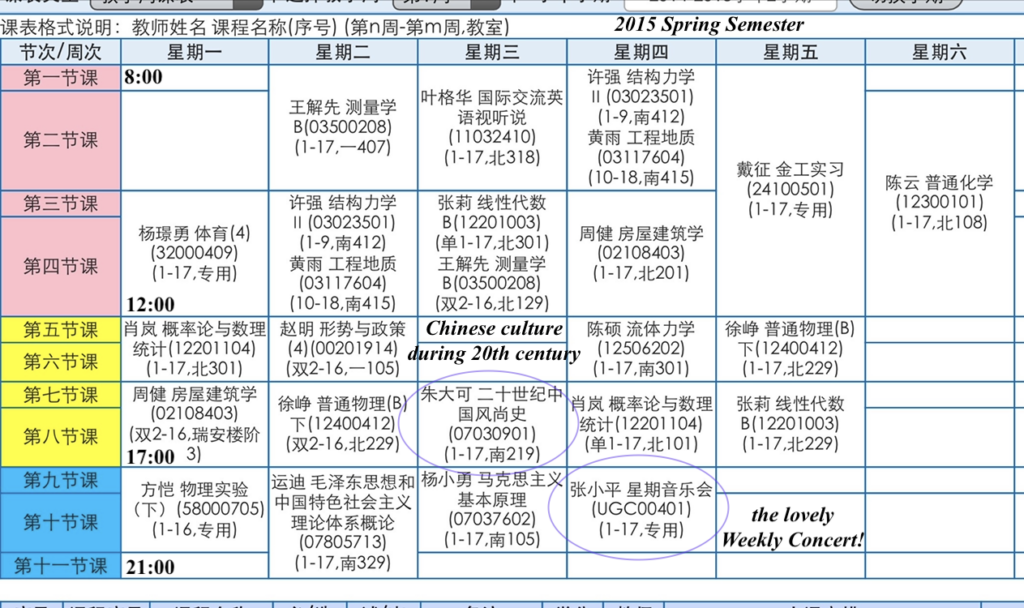
The courses I took during my sophomore year.
I. The good-old Yale musics course
A few weeks ago, one of my friends at KIV, Tetra, talked with me about music genre and history, which reminds me of a good-old music course I watched back in 2013 or so. It is a wonderful course teaching you how to get the most out of the music you are listening to. The course is provided by Yale and called Listen to Music. Back then, I briefly watched all the video lectures, but not followed every detail emphasized during the lecture. For example, when rewatching the first lecture, I noticed a key concept, the dominant, that I had missed during the first watch about 8 years ago. When you heard a dominant, you will strongly anticipate the tonic that resolves the dominant. That is the reason why you sometimes feel a piece of music is easy to anticipate and familiar even though it is your first time to hear it. What’s more, I had missed the piece from the Chicago shown in the end of the first lecture. Tetra pointed this piece out and recommended me the film version of the Chicago. I like it very much, and it was really a pity that I missed it 8 years ago.
I plan to go through each lecture carefully and slowly this time. The plan is to finish one lecture every week or every two weeks. I would definitely talk with Tetra about these lectures if possible; this would enrich the learning experience a lot!
II. Read Einstein’s biography
Einstein is, with no double, the idol of most theoretical physicists nowadays. When reading A. Zee’s group theory book in our last year’s group textbook-reading session, one biography of Einstein called, Subtle is the Lord: The Science and the Life of Albert Einstein, often appears in the end notes. Following Zee’s suggestion, I choose this book for casual reading this year.
III. More about Existentialism: Nietzsche, Sartre, Heidegger, and the Six Ancestor of Chan, Huineng
The question, how to live a meaningful life, is inevitable to every living beings. For the time being, I’m quite into the existentialism way of understanding the meaning of life. For me (it may be totally wrong though since I’m by no means an expert in this), existentialism says that the meaning isn’t there a priori. Instead, it is up to us to assign the meaning for ourselves. To quote Nietzsche, every day I count wasted in which there has been no dancing.
The source of my belief may mainly come from two places. One is the philosophy course about Heidegger I took in my freshman year, and the other is probably the Copenhagen interpretation of quantum mechanics.
The rough plan along this line is to read books related to Schopenhauer, Nietzsche, Sartre, Heidegger, and Huineng.